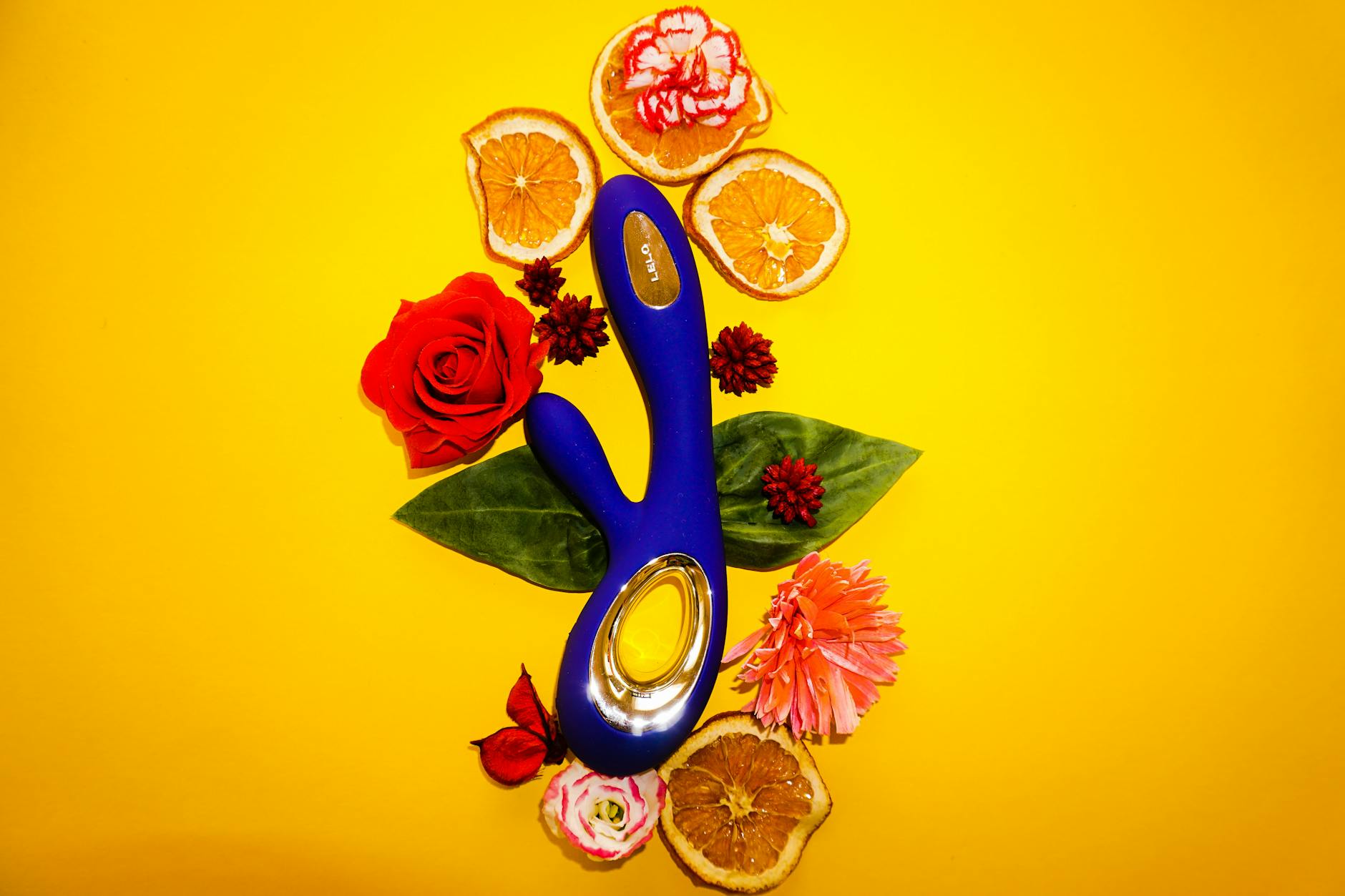
The awkwardness is real, and it's not about the toy
Here's what happens in long-term relationships: you've been intimate the same way for years, sometimes decades. The rhythm works. Nobody's complaining out loud. Then someone—usually the person with a vulva, if we're being honest—mentions the idea of a toy, and suddenly the whole dynamic feels loaded with subtext.
Does introducing a lemon vibrator mean I'm not satisfied? Is this a sign something's broken? Why now? If it was working before, why change it?
These questions aren't about the toy. They're about meaning. In long-term partnerships, sex becomes shorthand for security, familiarity, and the specific way you two express desire. Adding something new disrupts that language. The awkwardness you're feeling isn't a red flag. It's just the normal friction of renegotiating intimacy at a new stage of the relationship.
Why a lemon vibrator specifically eases that transition
There are lots of reasons couples resist toys. Some are practical (where do we put it, how do we talk about it), and some are deeper (feeling replaced, feeling inadequate, feeling seen in a way that's vulnerable). A lemon clitoral vibrator—specifically a device like the Lem—sidesteps several of these friction points.
It's not positioned as a replacement for your partner's touch. It's designed to complement sensation in a way fingers or a penis simply can't replicate. The suction mechanism delivers stimulation that's precise, consistent, and concentrated in a way that builds to something different than traditional penetration or manual stimulation alone.
For long-term couples, this matters. You're not trying to outperform your partner. You're exploring a third element together. It's addition, not subtraction.
Second, the design itself is less intimidating. A lemon clitoral vibrator looks intentional and aesthetic—it's not trying to hide what it is. Many couples find that a beautifully designed toy feels less clinical and more like a shared object of pleasure, something you picked out together rather than something that showed up in a plain brown box and now lives in awkward silence in the nightstand.
The conversation that actually works
Most couples get stuck here. They either avoid bringing it up (which builds resentment) or bring it up wrong (usually late at night, during or right after sex, when defensiveness is highest).
Try this instead: pick a time when you're not intimate, not rushed, and actually clothed. Bring it up the way you'd bring up any shared purchase or experience. "I've been thinking about exploring some things together" works better than "I want to use a vibrator on myself." Frame it as joint curiosity, not individual need.
Be specific about why you're interested. If it's because you want to reach orgasm more easily, say that. If it's because you're curious about a new sensation, say that too. The more you demystify the request, the less it feels like a referendum on your partner's performance.
Listen to what they say back. Often, the initial reaction isn't the final position. People need time to sit with the idea. If your partner seems hesitant, ask what's making them uncomfortable. Sometimes it's just logistics (how to use it, where to source it). Sometimes it's deeper (fear of inadequacy, past shame around sex). Both are solvable, but you need to know which one you're dealing with.
How to introduce it together without the weirdness
Once you've had the conversation and you've agreed to try a lemon vibrator, the next moment matters enormously. You're establishing a new template for how you talk about pleasure together.
Start solo if that feels easier. Use it on your own first, figure out what you like, get comfortable with the sensation. When you've had a few solo experiences, you know what you're inviting your partner into. You're not discovering it together from a place of mutual uncertainty.
Then, frame the first time you use it together as exploration, not performance. You're not trying to have the best orgasm of your life. You're trying to see what happens when a lemon clitoral vibrator enters the picture. Lower the stakes dramatically.
One practical note: communication during is underrated. If your partner is using the toy on you, tell them what you're feeling. "That's intense" or "I like it there" or "I want to move it slower." This accomplishes two things. First, it makes the experience feel collaborative instead of one-directional. Second, it gives your partner permission to be engaged and curious rather than anxious about whether they're doing it right.
If you're using it on yourself while your partner is present, let them watch if you want. Lots of couples find that seeing their partner in pleasure is its own kind of turn-on. It normalizes the toy and turns it into something that's part of your shared sexuality rather than something imported from outside.
What to expect in the weeks after
Introducing a lemon sexual toy doesn't automatically mean you'll use it every time. It shouldn't. The goal isn't to replace your old patterns. It's to expand your range.
Some couples find they use it once and then shelve it for months. Others integrate it into their regular rotation. Both are fine. The point is that you've added an option to your toolbox. The awkwardness fades when the toy becomes mundane—just something you use sometimes, like a particular position or a particular time of day.
Talk about how it felt afterward. Not in a clinical way, but casually. "That was different" or "I liked how my body responded to that." These small comments normalize it and keep the conversation open for future adjustments.
If something didn't work—if it hurt, or it felt weird, or it killed the mood—say that too. Not in a blaming way, but as information. "I think I need more lube with that" or "Let's try a different pattern next time." You're problem-solving together, which is actually one of the most intimate things a long-term couple can do.
Why this matters for your relationship
Intimacy is a language. In long-term partnerships, that language can get stuck. You develop patterns because they work and because they're safe. But safety can calcify into routine. Routine can start to feel obligatory. And obligatory sex is one of the fastest ways to erode connection.
Introducing something new—whether it's a lemon clitoral vibrator, a different location, a conversation about fantasy—is a way of saying "I want to keep discovering pleasure with you." It's not a critique of what you've had. It's an investment in what you're building.
When couples approach a toy as a shared project rather than a problem to solve, something shifts. You're not performing for each other. You're collaborating. You're acknowledging that pleasure is complex, that bodies change, that desire evolves. A Hello Nancy lemon vibrator becomes a symbol of that evolution, not a threat to it.
The awkwardness you feel right now is just the friction of growth. It passes.
FAQ: Long-term couples and toys
Why does introducing a toy feel like a threat to my partner?
In long-term relationships, sex often becomes a proxy for security and being desired. A toy can feel like criticism—"you're not enough"—even when that's not what's being communicated at all. The best antidote is separating the two conversations: "I want more pleasure in my body" is different from "I want more pleasure with you." You can want both.
How do I know if my partner is actually okay with this, or just going along with it?
Pay attention to what happens after the conversation. Does your partner bring it up again? Do they seem curious or just resigned? True agreement usually shows up as questions ("How does it work?" / "What made you interested?") rather than silence. If it feels forced, pause and ask directly: "I'm sensing some hesitation. What's really going on?" Forcing it never ends well.
Will using a lemon vibrator make my partner feel inadequate?
Sometimes, initially. But that feeling usually passes once they see you experiencing pleasure. A lot of partners find that watching their significant other use a lemon clitoral vibrator is genuinely arousing. It makes them feel invited into your pleasure rather than replaced by it. Frame it as "I want you to be part of this" rather than "I need this without you."
How often should we use a lemon vibrator together?
There's no "should." Some couples use it regularly. Others use it occasionally. Honestly, the magic is in the fact that the option exists. You might use it weekly for a month, then not again for six months, then rediscover it. That's all normal. Let it be responsive to your desire rather than another performance metric.
What if we try it and it doesn't improve things?
Then you have information. You learned something about what does and doesn't work for your body and your partnership. The toy itself isn't the point. The point is renegotiating intimacy and showing up with curiosity instead of assumption. If you're struggling more deeply—if sex has felt off for a long time, or if there's resentment underneath—that's worth talking to a therapist about. A lemon vibrator can enhance pleasure, but it can't fix broken communication.
Is it weird to use a lemon vibrator if we've been together 20+ years?
Not even a little. Long-term couples often have the most to gain from exploring new pleasure because you have a foundation of trust and safety. You know each other's bodies, you have shorthand for communication, and you've weathered enough change that a new toy is genuinely low-stakes compared to, say, a new relationship navigating these conversations. The longer you've been together, the more permission you have to experiment.
Keep exploring together
Introducing pleasure devices into a long-term partnership is awkward, yes. But it's also a chance to deepen how you talk about desire, curiosity, and what you both want from your bodies. A lemon vibrator from Hello Nancy is just the vehicle.
If you're feeling stuck on how to start or what to say, reach out. Connect with us to talk through what might work for you and your partner.