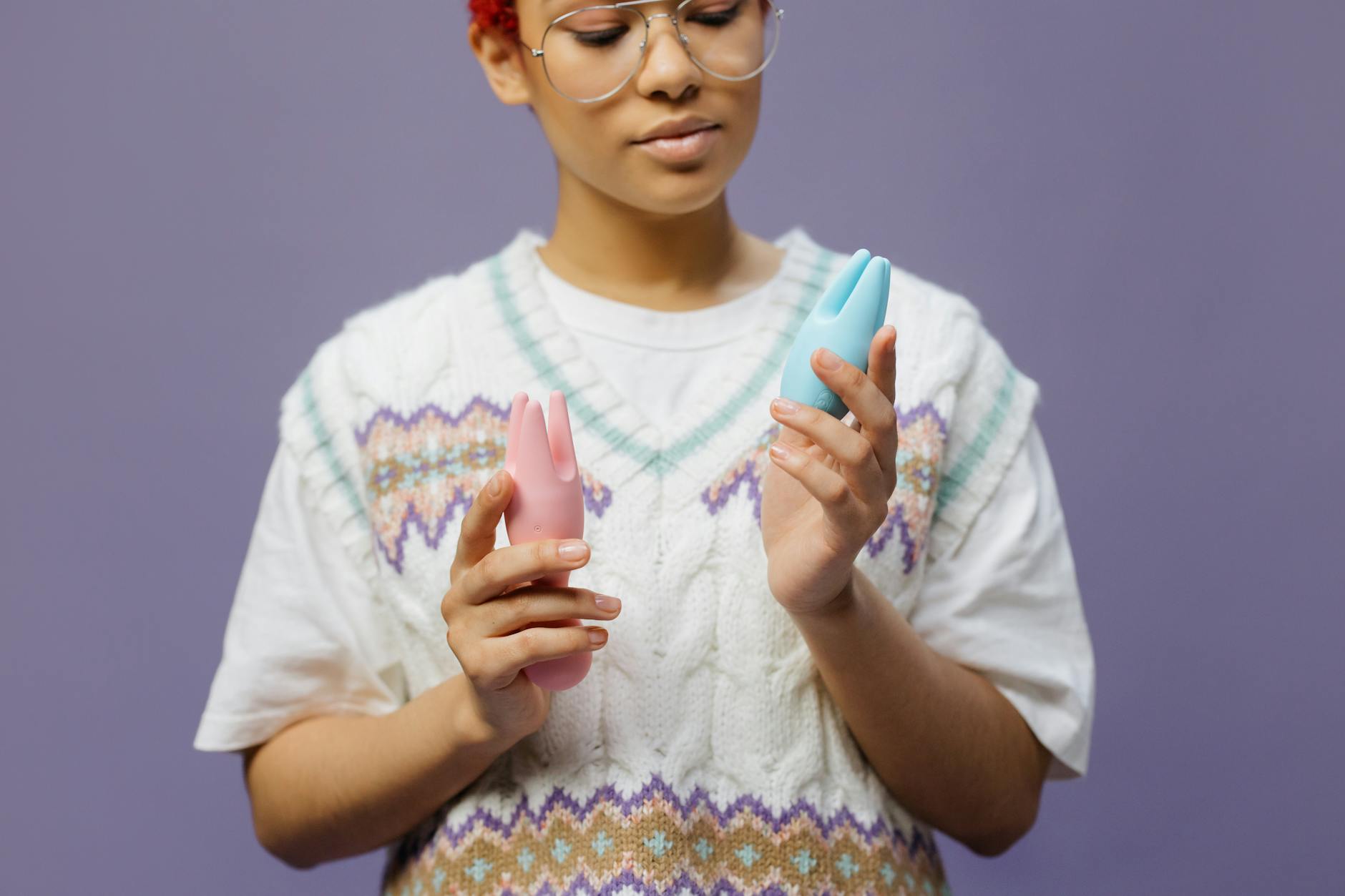
Let's start with the honest part
Your hormones are literally changing how quickly your body becomes aroused. This is not in your head. It's not about your relationship or your confidence. It's neurobiology.
Each week of your cycle, your estrogen and progesterone levels shift in a specific pattern. Those shifts change blood flow to your genitals, sensitivity in your nerve endings, and how fast your brain responds to touch. On some days, you can be ready in five minutes. On others, you genuinely need twenty. Neither is wrong. Both are worth understanding.
This matters because a lot of people think their arousal is broken when it's really just operating on a different timeline. And if you're using a clitoral vibrator like the Lem, matching its intensity and approach to your actual hormonal state makes the difference between pleasure that feels forced and pleasure that feels inevitable.
How your cycle actually changes arousal speed
There are roughly four hormonal phases, though most people talk about two. Here's what's actually happening.
Follicular phase (days 1-14 of your cycle). Estrogen is rising. This is when your genitals have the most blood flow, tissue sensitivity is highest, and arousal typically builds fastest. Your vaginal lubrication increases. Your clitoris feels more responsive. This is the phase where a lemon vibrator often feels most immediately pleasurable because your tissue is naturally primed.
Ovulation (days 13-15). Estrogen peaks right before ovulation, then drops sharply. You often get a brief window of intense sensitivity here. Some people report that their most intense orgasms happen during ovulation because of this hormonal peak. Then the drop feels like a wall.
Luteal phase (days 16-28). Progesterone rises, estrogen dips. Blood flow to your genitals decreases slightly. Arousal takes longer to build. You might need more direct stimulation or longer warm-up time. This is not a flaw. It's just a different timeline. A lemon clitoral vibrator works beautifully here, but you might start at a lower intensity setting and give yourself more time.
Menstruation (days 1-5, roughly). Hormone levels are at their lowest. Some people feel completely disconnected from pleasure. Others report heightened sensitivity because of increased pelvic blood flow during menstruation itself. It's highly individual.
The pattern repeats every month. And if you're on hormonal birth control, you don't get these peaks and dips at all. Instead, you get a flat, consistent hormonal state. Which means arousal timing stays roughly the same all month, but it's often slower than your natural peak.
Why matching your vibrator use to your phase matters
You're not going to spontaneously become aroused if you're not hormonally set up for it. Willpower doesn't change blood flow. Desire doesn't overcome physiology. So if you're trying to use a lemon vibrator during your luteal phase with the same intensity and duration you used during ovulation, you're fighting your own biology.
Matching your approach to your cycle means:
- Follicular phase: Start with higher intensity settings (patterns 4-8 on the Lem). You can go harder because your tissue is naturally more resilient and responsive. Build time is usually 10-15 minutes. Arousal typically feels natural and available.
- Ovulation: You might need less time but want more intensity. This is the sweet spot for experimentation because sensitivity is peaked. Even gentle stimulation can trigger orgasm. Some people use the Lem for just 5-10 minutes here and find it overwhelming.
- Luteal phase: Start lower (patterns 1-3) and be patient. Budget 20-30 minutes for warm-up. Use more lubrication because tissue is naturally less engorged. Think of it as slow-build pleasure, not fast-trigger pleasure. A lemon vibrator is perfect for this because the suction mechanism doesn't require the same tissue resilience that direct vibration does.
- Menstruation: Experiment. Some people skip pleasure entirely during their period. Others find that menstrual cramping actually responds well to gentle clitoral stimulation. If you do use the Lem during menstruation, keep settings low and focus on what feels good that specific day.
The logistics of tracking your arousal timing
Honestly, you don't need a complex system. You need one piece of information: approximately where you are in your cycle.
Free tracking apps (like Clue, Flo, or even just a calendar note) take two seconds to update each day. You'll notice patterns within two or three cycles. You'll start to feel the difference between your follicular fast-build arousal and your luteal slow-build arousal.
Once you notice the pattern, you can adapt in real time. The night before, you already know which phase you're in. You can choose your approach accordingly. You can tell a partner, "Hey, I'm in my luteal phase. I'm going to need more time today." That's information, not an apology.
If you're on birth control, you still experience some fluctuation. Progestin-only methods (like the mini pill or IUD) allow more natural hormone variation than combined pills. You might still notice a subtle rhythm, especially around your placebo week. Worth tracking just to know your personal pattern.
How your partner fits into this (or doesn't)
If you're using a lemon vibrator during partnered sex, cycle awareness changes the conversation. Your partner doesn't need to become a hormone expert. They just need to know that your arousal timing changes, and that's normal.
Luteal phase is often when people want more foreplay or more time with the Lem before penetration. Follicular phase is often when arousal feels faster and people want to move more quickly. That's not about your partner being less attractive or the relationship being boring. It's about your body having different timelines depending on the week.
If your partner thinks they did something wrong when your arousal slows down in the luteal phase, that's a separate conversation. It's worth having. You might even show them the research. But the vibrator itself gives you a tool that works across all phases. That's valuable.
When tracking patterns reveals something deeper
If your arousal timing is genuinely chaotic—inconsistent from cycle to cycle, unpredictable, or if you're noticing other symptoms like intense period pain or mood shifts—that's worth mentioning to a doctor. Some hormonal conditions (like PCOS or endometriosis) can affect both arousal timing and pleasure. A gynecologist or a menopause specialist can help you understand what's actually happening.
The same goes if you've recently changed birth control. Your cycle adaptation might take 2-3 months. You might feel disconnected from pleasure for a bit while your body adjusts. That passes. Using a tool like the Lem during that adjustment period can actually help you stay connected to your body while hormones shift.
The real permission here
Your arousal doesn't need to be fast to be legitimate. Some of the most intense, most satisfying orgasms happen during slow builds in the luteal phase. You're not broken if you take twenty minutes. You're not high-maintenance if you need a different approach each week. You're just human, and your body is doing exactly what it's supposed to do.
A lemon clitoral vibrator is brilliant here because it works across all your phases. You're not buying a different toy for each week of your cycle. You're just adjusting the same tool to match your body's actual needs. That's smart, adaptive pleasure.
People also ask
How long does it take for your arousal speed to change when you switch birth control?
Your body usually needs 2-3 months to fully adjust to a new hormonal contraceptive. You might feel a shift within a week, but the real stabilization takes three cycles. Your arousal timing during that adjustment period might feel unpredictable. That's normal. It settles down once your body adapts to the new hormone dose. Some birth control methods (like pills) cause more variation in arousal than others (like consistent-dosage IUDs).
Can you have a good orgasm if you're in your luteal phase and arousal takes forever to build?
Absolutely. Slow arousal doesn't mean weak arousal. In fact, slow builds often lead to more intense, more sustained orgasms because more blood is gradually flowing to your genital tissue. You're building tension steadily over time instead of a quick spike. A lemon vibrator is particularly good during this phase because the suction mechanism can work on tissue that's less immediately engorged. The orgasm itself is often deeper.
Does cycle syncing actually work, or is it pseudoscience?
The hormone fluctuations are absolutely real and measurable. The changes to blood flow, tissue responsiveness, and lubrication happen every cycle. What's less proven is the idea that your energy, strength, or productivity shifts in perfect alignment with those hormonal changes. The research is mixed. But for arousal timing and sexual pleasure, the biology is solid. Your cycle does change how fast and intensely you become aroused.
What if your arousal timing doesn't match the typical cycle pattern?
You might have a naturally slower or faster arousal response regardless of where you are in your cycle. Some people are just slow-builders. Others respond instantly to any stimulation. Your baseline matters more than the stereotype. That said, you'll still usually notice some variation across your cycle, even if it's subtle. And a lemon vibrator adjusts to your pace either way.
Can you use a lemon vibrator while on your period?
Totally up to you. Some people find that gentle clitoral stimulation with a lemon vibrator actually helps with period cramping because it increases blood flow and releases endorphins. Others prefer to skip pleasure during menstruation. There's no right answer. If you do use the Lem during your period, keep intensity lower, use extra lubrication, and listen to what feels good that day. Your tissue might be more sensitive, or it might feel fine. Only your body knows.
How do you actually remember what phase you're in if you're not tracking?
Honestly, just track. It takes five seconds a day. Write a dot on a calendar, or use any free app. After three cycles, you'll know your pattern by feel. You'll notice the shift in how you wake up, how your energy feels, how your body responds to touch. But for the first few cycles, making it explicit helps. You can't trust memory when hormones are literally changing your perception of time.
The takeaway
Your arousal isn't broken when it's slow. You're not asking too much when you need more time some weeks. Your body has a monthly rhythm, and it's smart enough to shift its responses based on hormonal reality. A lemon clitoral vibrator works beautifully across all of your phases because it's adaptable. You just need to know where you are in your cycle and adjust accordingly.
If this resonates with you and you want more guidance on navigating arousal changes through relationships and life transitions, get in touch. We can talk through what's happening with your body and your pleasure. For now, track your cycle for one month. Notice the shifts. Adjust your lemon vibrator approach as you learn your pattern. That's where clarity and pleasure meet.